
Long Island Horticultural Society
April News &Notes
President's Message...

Ronnie Branczio
Hi Fellow Plant-Lovers,
I am writing this on April 1st, otherwise known as “April Fool’s Day”. Well, I have no intention of pulling any tricks or jokes on you, but Mother Nature has been at it for quite a while! It’s hot! It’s cold! Better start working outside! Whoops, not yet - it’s freezing out there! You know what I mean.
Today is quite mild, and I finally got out there and started cleaning up the flower beds. And of course I discovered that I waited too long and should have started much earlier! Most tulip and daffodil leaves had bravely pushed through, but a few were thwarted by a mat of wet autumn leaves. I hope I rescued them in time. Ditto for some mini shrubs that I had planted - I can only hope for their survival!
On the positive side, I did my first spring check-up of the mature plantings in the garden, and found buds on all my old-faithfuls, including Japanese Maple, St. Johnswort, Spirea, lilac, and many others. Forsythia is in full bloom, two varieties of hellebore are loaded with flowers, but witch hazel is about done. Crocus and Daffs are in full bloom, tulips not quite yet. Even the neglected bulbs that I shoved into pots late in the winter have taken root and are about to bloom - very kind of them!
Our April Speakers will help us get into the gardening mood while reminding us of some of the best ways that we can be good caregivers of our own gardens and of our natural environment. The topic will be “Composting”, and will be presented by two members of the Long Island Organics Council.
This meeting will be shortly before Arbor Day, and our Exhibition Table will feature a timely display on “The Trees of Long Island”, which is a historic publication jointly created by LIHS and PFA in 1973. If you have any other ideas or materials to contribute to the topic of Trees, please let us know and we can add them to the display.
I hope you are all sharing my pleasure in this season of renewal and natural beauty.
I wish you joy in your celebration of Passover or Easter, or however you welcome this beautiful time of year.
Happy Gardening,

April 19 Meeting

Speaker: Madeline Infantino & Long Island Organics Council
Topic: Home composting for residential gardeners
For more information please visit the Meetings page
Doors open at 12:30pm
Place Horticultural Competition entries by 1pm.
1pm Seed Swap - See Details below
1:30 - 2pm LIHS Business, Announcements
Speaker starts at 2pm
Please consider donating
refreshments to the hospitality table.
March 8 Horticultural Competition

Div 1 Class 1 Section A Ikebana Arrangement Phalaenopsis Orchid & Amaryllis Leaf

Div 2 Class 7 Section B Vanda Orchid

Div 2 Class 6 Section B Cactus
Div 1 Class 1 Section A Ikebana Arrangement Phalaenopsis Orchid & Amaryllis Leaf
Click on gallery to view slideshow
Horticultural
Ann Wetzel 1st Place Div 1 Class 1 Section A Ikebana Arrangement Phalaenopsis Orchid & Amaryllis Leaf
Maureen Wawrzonek 1st Place Div 2 Class 7 Section B Vanda Orchid
Botanical Arts
Ronnie Brancazio 1st place Div 3 Class 1 Watercolor Painting "My Patio"
Barbara Hanft 1st Place Div 3 Class 2 Photograph Dahlia
2026 LIHS Scholarship Update by Carlos Taborda, Scholarship Chairperson
The Scholarship Committee has received five applications for the 2026 award. The committee is currently reviewing these applications and will notify the winner on April 16th. The award will be presented at our May 17 Meeting
Welcome New Members
Abigale Fredsall
Patricia Getter
Lorraine Jaworski
Kathleen Lambot
Tara Sammis
Geri Weiss
Kameelah Wright
Epcot Flower & Garden Festival
by Kathy Readinger
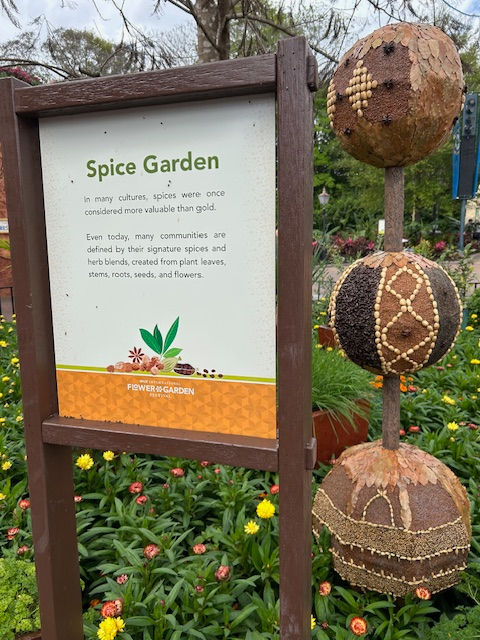
The annual Epcot Flower & Garden Festival is currently on display in Orlando, Florida, from March 4 - June 1, 2026. So many beautiful, and often whimsical, gardens are available to enjoy as you walk through the park. These pictures were taken on March 16 during our Epcot visit.
Click on Gallery to see full size photos
© Kathy Readinger


Annual Seed Swap

Our Annual Seed Swap will take place at the April 19 Meeting at 1pm. Bring Seeds to Take Seeds! Grow something different this year!

Volunteers Needed
History Committee is looking for a member historian to join our committee to help organize, classify, and catalog the many years of history our Society has accumulated.
Also, if anyone has experience setting up a searchable database for digitalized documents of the long history of our organization please contact Carlos Taborda either at a meeting or send an email to
From the editor....
_edited.jpg)
I have been creating Ikebana arrangements for over 5 years now. It was one of my pandemic projects. I learned via a combination of Youtube artists and the internet. I learned the basic Morabana arrangement, with Shin which represents heaven and is 1 & 1/2 the length and width of the container. Soe represents man and is 3/4 the length of Shin and Hikai or Tai represents earth 1/3 the length of Shin, in the upright or slanting styles.
In the beginning I remember thinking as I'm trying to get the stems in the correct position and angles that this was anything but relaxing, lol. I was still learning the basic principles and until one learns that, practice is your friend and it not going to be a relaxing endeavor. Once your have the basics memorized then you can move onto studying the branches reflecting on the arrangement and enjoying the process much more. I now can focus on the most important aspects which is creating beautiful lines. You can use branches to create lines or use long leaves to create lines, like from daylilies or gladiolus.
A big thank you to Marge Duryea for giving me lots of branches from her garden for me to work in my arrangements for the last 2 meetings.
Master Rijo Miyamoto has a Youtube channel and I have learned so much from him. While he does teach the basics he focuses much more on creating beautiful lines and creating and using negative space to enhance the beauty and appreciation of each individual flower. Otherwise known as editing which I was and still am to some degree very bad at. It is hard to cut off flowers. One of the best tips he gave in a recent lesson is to stand back and look at your arrangement from afar. Sit with it for awhile and just see if the arrangement looks balanced. That becomes part of the relaxing meditative process as well.
I also learned a lot of tricks from another Youtube Ikebana artist, Ikebana by Junko, she has since retired now so no new videos are being produced but her channel is full of great tips for making interesting arrangements and how to fix (secure) materials. I highly recommend watching both of these Ikebana artists to learn more about how to create and appreciate Ikebana.
I have put together a gallery of my past ikebana arrangements, some more successful than others and I will write a critique in the slideshow below. I have also included some of the diagrams I first used when I was just starting to learn how to create an ikebana arrangement.
-Ann Wetzel


Beautiful lines created from curled Amaryllis leaves. Phalaenopsis Orchid flower on stem and floating in the water. Beautiful arrangement focus on creativity and expression.
Check out the Garden Calendar page this month for All the jobs that need doing
LI Hort Monarch Butterfly Garden Project

In order to plant our new garden in May we are asking for your help.
The list of native flowering plants that will be included in the garden is below.
If you are growing any of these in your garden, or starting them from seeds, and would like to donate some to our new garden, please email or text Laura Weill at lihorticulturalsociety@gmail.com who is keeping track so that we have enough to fill our new garden.
Please send the plant name and estimated number of plants to her by April 11th and thanks in advance for your help. Please send email to
Symphyotrichum laeve Smooth Blue aster
OR S. novae angliae New England aster
OR S. novi belgii New York aster
Coreopsis Tickseed
Eupatorium coelestrinum Mistflower
OR Coloclinium coelestinum
Echinacea purpura Coneflower
Solidago luteus Goldenrod
Helenium autumnale sneezeweed
Hibiscus moscheutos Rose Mallow
Agastache scrophularifolia Giant Hyssop OR Anise Hyssop
Eutrochium purpureum Joe Pye Weed
Liatris scariosa Gay Feather
Asclepias syriaca Common Milkweed
OR A. incarnata Swamp Milkweed
Monarda didyma Bee Balm/Bergamot
OR M. fistulosa Wild Bergamot
Lobelia siphilitica Great blue lobelia
Ronnie's Recap

On Sunday, March 22, LIHS Members and Guests were treated to an highly informative, graciously presented, and visually beautiful demonstration of the ancient Japanese art of Ikebana.
Our Speaker was Chiaki Torisu, and her Topic was “The Art of Ikebana: Seeing Nature Through Japanese Flower Arrangement."
Chiaki arrived beautifully dressed in a Japanese Kimono and bowed to us as we welcomed her, thus setting the tone of peace, harmony, and calm that graced her presentation. She began with a clear and concise history of Ikebana, telling us about several of the early Masters, the different Styles, and the basic Structure of an Ikebana Arrangement. Her particular style is called Sogetsu, and it was founded in 1927 and represents a more modern and less rigidly structured style.
She explained through clear slide illustrations and live demonstration that there is a three-part structure to each arrangement, consisting of a tall, upright branch called the “Shin”, a medium branch placed at a 45 degree angle called the “Soe”, and
Hikae the lowest branch. In addition several "filler" flowers called “Jushi” are used to support Shin and Soe. All are placed within the “Kenzan”, or base (a pin frog is used to anchor each branch or flower).
Chiaki demonstrated her art by creating two Ikebana arrangements in shallow, round containers, using a variety of branches, flowers, and leaves she had brought. As she worked, she explained her plant choices, showed how she measured each piece and cut and placed it precisely, and kept evaluating and carefully adjusting the elements to her satisfaction. She noted that Ikebana arrangements are structured from back to front rather than side-to-side or in the round.
The two pieces were simple, beautiful, and evoked a feeling of meditative serenity. She generously donated both arrangements for our Raffle, so that two lucky winners got to bring home an original creation to enjoy.
We thank Chiaki for this fascinating, thoughtful, and beautifully presented learning experience.


Thank you to
Priscilla Bauerschmidt for the Hospitality Table Centerpiece.

Donations to the Hospitality Table: Suzan & Dale Goldstein, Debi Goldfisher, Toni & Stuart Germain, Laura Weill, Sharon Rubin, Muriel Drew, Rosemarie Papayanopulos, Joan Insogna, Roberta Roberts, Maureen Wawrzonek, Art Papayanopulos, Francine Reff
Donations to the Raffle Table: Russ Gorog, Laura Weill, Toni & Stuart Germain, Rosemarie Papayanopulos, Trish Cody, Barbara Hanft, Beth Costello
Membership Form

Dues for membership are:
Single $35, Household: $45, Student $5
Please fill out the Membership Form here on the website, when renewing or joining. Just type your information into the form and print it out. Bring it with your dues to a meeting or mail it to the address on the bottom of the form.
Cook's Corner

This month's recipe comes from past speaker, Ellen Ecker Ogden, Quinoa & Arugula Salad
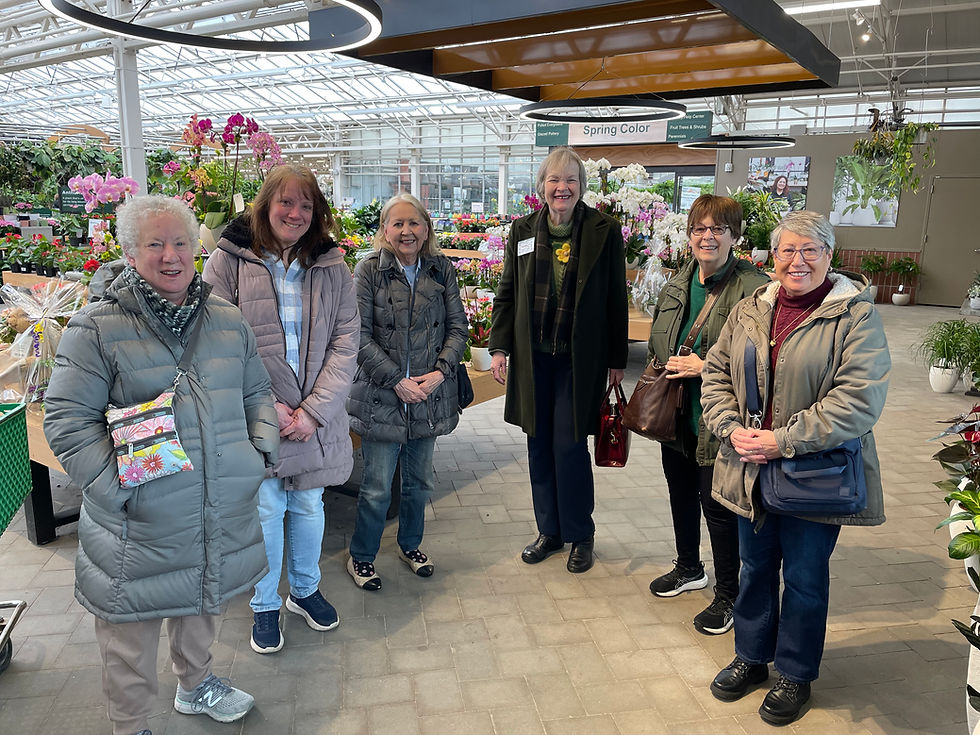
Hicks Flower Show Meet up March 19,2026, Photos © Courtney Quinn



Philadelphia
Flower Show
by Patty Jarrett
On March 7th, Len & I took a drive to the Philadelphia Flower Show at the Pennsylvania Convention Center. The theme for 2026 was “ROOTED: Origins of American Gardening”. From the moment that we entered the exhibit, we were mesmerized by the displays. According to the PHS website, the exhibition includes the largest plant competition in the world. Some of our favorite competitions included the miniature settings, pressed plants, botanical couture, botanical jewelry, the landscape design, & the floral arrangements.
Click on Gallery to see full size photos
© Patty Jarrett


Care for Spring Bulbs

Consider removing winter mulch. Last fall you should have added a nice layer of organic mulch to protect the spring-flowering bulbs from wild temperature swings during the winter.
Once the flowers have faded, deadhead them. This allows the plant to put energy into restoring the reserves of the bulb instead of producing seeds.
Leave the foliage on spring-flowering bulbs until it turns brown. The bulb needs the foliage to gather energy to replenish the bulb so the plant can return next spring.
Spring often comes with ample rain to sustain your bulbs while they're in active growth, but should there be a dry period, water them.
Fertilize your spring-flowering bulbs, but avoid mixes high in nitrogen. The University of Illinois Extension recommends applying a slow-release granular fertilizer rated 10-10-10 when bulb foliage breaks through the soil in the spring. If you missed this window, you can apply a liquid fertilizer after the bulbs flower, instead. If you want to skip fertilizers, top-dress the bulbs' area with compost in the fall, which will improve both soil health and drainage.
Some spring-flowering bulbs, especially daffodils, can develop into thick stands. The competition can lead to diminished flowering. Every few years, carefully dig, divide and replant the bulbs at proper spacing so that they can continue to thrive and bloom
Spring is also an excellent time to observe garden areas that could use more bulbs and make notes to add them in fall.